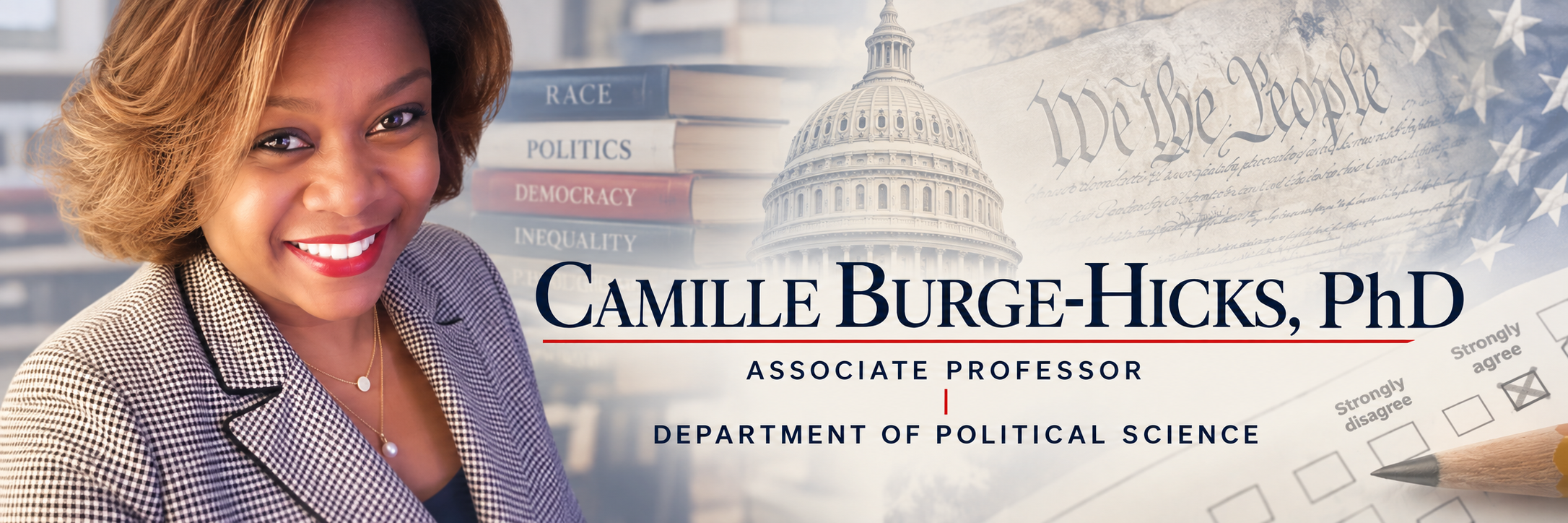
Camille Burge-Hicks is an Associate Professor in the Department of Political Science at Villanova University where she currently serves as Department Chair. Camille was born in Oklahoma City, Oklahoma and raised in Alpharetta, Georgia. Prior to joining Villanova in the Fall of 2014, she received her Bachelor of Arts in Political Science from Bethune-Cookman University and a Master’s and PhD in Political Science from Vanderbilt University.
Camille’s research and teaching areas of expertise lie within Political Psychology, U.S. Public Opinion and Political Behavior, and Racial and Ethnic Politics Her research has been published in several top tier academic journals and featured in edited volumes and public-facing outlets like PsyPost, Politico, The Philadelphia Inquirer, and The New York Times. Her book, Fired Up or Ready to Go: Pride, Shame, and Anger in Black Politics, is forthcoming with Cambridge University Press. She is also a co-editor of New Directions in Black Political Psychology, which is forthcoming with University of Michigan Press. She is a mixed methodologist that specializes in focus groups, content analyses, and survey design and implementation. Camille is an award-winning teacher, receiving the Junior Faculty Award for Excellence in Teaching in 2018 and the Christian R. and Mary F. Lindback Award for Outstanding Teaching in 2021.
Camille is active in real-world politics. She is a highly sought after public speaker and has given over sixty public lectures on American politics, appeared on segments of CNBC, and can be heard numerous times on National Public Radio. In 2019, Camille was appointed to the 2020 Pre-Election Polling Task Force for the American Association for Public Opinion Research (AAPOR) where she worked alongside several academics, statisticians, and survey leaders to analyze local, state, and national elections data. She currently serves as the Education Chair on the Executive Council of AAPOR and co-leads the House of Representatives Team on the ABC News Election Night Decision Desk where she uses rigorous statistical analyses to project election outcomes.

